Historical Thinking Skills |
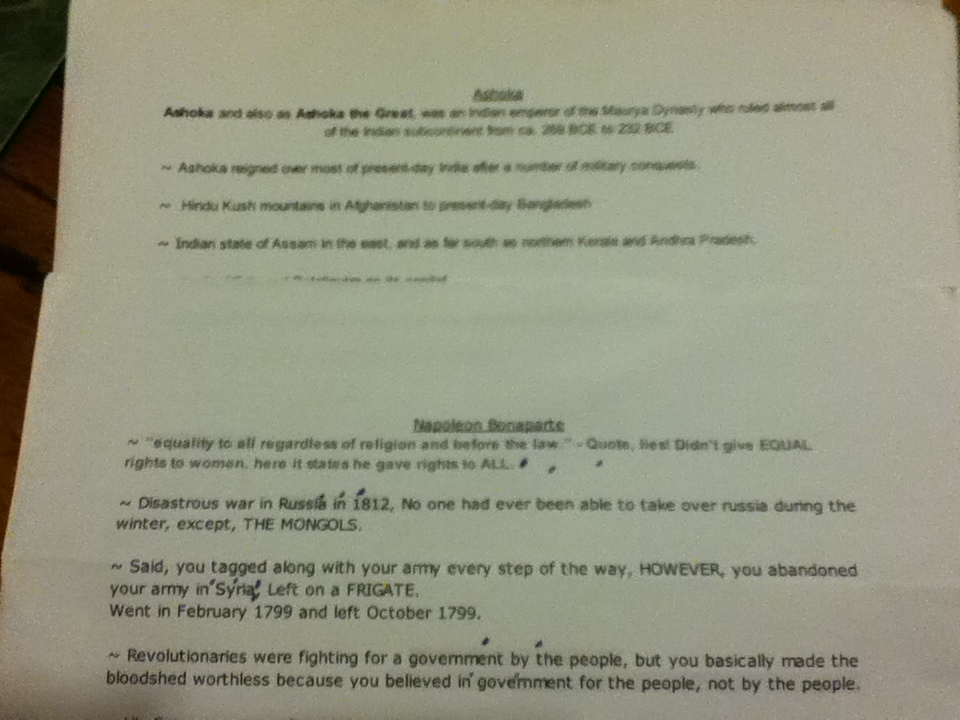
HTS 1: Crafting Historical Arguments from Historical Evidence Reflection: Throughout the year, Mr. Rodriguez taught us skills crucial to AP students. Some of those including how to form an argument and backing it up with historical evidence. A perfect instance in which I had to do this was during March Madness, when debates to determine who was the ruler of the world began. I had to use historical evidence to create an argument that would benefit my character (Ashoka, which is the best ruler in the world, in my opinion), I also had to create arguments that would destroy my opponent. Also, in another instance in which this skill came in handy was when Mr. Rodriguez assigned us the Dinner Time Project, in which we had to create a possible conversation between Zheng He, Ibn Battuta, Marco Polo, and Mansa Musa, based only on what we had researched about them. However, the most obvious way I was able to exercise this skill was by writing DBQ Essays. This required me to read documents and understand what the author was trying to get across to their audience, without directly quoting the document, it also required me to understand a group of documents well enough to form connects between them, and create a valid argument. I believe this skill doesn't only come in handy for scholastic works, but also in life. We learn to analyze things further than what is just above and what we can clearly see, as we had to do with documents by understanding the purpose of the document, and why it was being written. Evidence: In the picture below is a few notes I took for my debate against Napoleon Bonaparte. The way I created this specific set of notes was after listening to my soon to be opponents' arguments, and began to create points that would counter their claims and be able to create a valid counter argument. By backing up my arguments with relative information like years, and events, I was successful in defeating several opponents.
|
HTS 2: Chronological Reasoning Reflection: Among the array of skills learned this year, one of them would also be historical causation. Being able to connect cause and effect in between time periods, or within a time period. This skill was clearly exercised when I had to write a Continuity and Change Over Time Essay. The first action I took when writing an essay of this sort was create a timeline and write down any and all events that I could think of off the top of my head from the time period given, then write down anything else that came to mind. Although some information came to be false, with in all those points, there had to be at least a couple of true statements that would cause me to earn a few points on the Essay. The Chinese Dynasty song was a crucial aspect during the AP test, because I chose it to be the skeleton for my timeline, however, it also worked for understanding how the past often influences future events. Yet, another skill I learned this year was understanding why periods of time are cut into blocks. For example, the reason why the last block studied in AP World History is 1900's to the Present, is because in this time, it was the era of conflict, but it was also the time in which scientific advancements did not necessarily occur for the well being of the people, rather to show dominance and power in the world. Showing dominance has always been a trend, specifically evident by the building of monumental structures like Ziggurats in Mesopotamia, and The Forbidden City in China. Evidence:
The Picture below shows evidence of my claim in which I stated that the Dynasty song was the skeleton to my time line. In this particular picture, I was aided by some classmates and Mr. Rodriguez a couple days before the AP Exam in creating this study poster. We connected events that occurred during the existence of Classical Civilizations, in the Eastern Hemisphere, but also stated the existence of the Mayan Civilization and how it developed agriculture spontaneously. 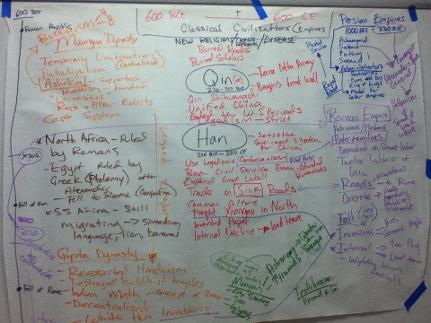 |
HTS 3: Comparison and Contextualization Reflection: Another skill I vastly focused on and learned this year was Comparison and Contextualization. We evidently practiced this skill by writing Similarities and Differences Essays. By doing so, I was able to compare developments between various societies. This skill was made easier to learn with the use of the SPICE elements. For example, at one point in the year we had to write a comparison essay about the spread of Christianity and Buddhism, by using the SPICE elements and historical evidence, one could compare the spread of religions as prominent on trade routes, and use of missionary activity, however Christianity was a monotheistic religion while Buddhism was a polytheistic religion, which allowed it to blend with other religions at a much higher level than Christianity. Another skill I learned this year was Contextualization, where I learned how one action directly affects another. A simple way I learned how to use this skill was by filling out Cause and Effect handouts. Which would allow me to analyze how one an event or events caused the outcome of another. For example, the Treaty of Versailles would be the core reason why Hitler would be so influential to the German people, leading to the Holocaust and World War II. For example, when studying the Cold War in the late 1900’s I understood that the creation of NATO by the United States directly influenced the creation of the Warsaw Pact by the Soviet Union. Comparison and Contextualization skills are crucial to AP students due to the extensive use of these skills on the AP Exam. Evidence: Below is a picture of one of my first Comparison Essays, we were asked to compare early civilizations. In this particular essay, I chose to compare China and Egypt. A similarity between civilizations would be that both existed along river valleys, however, a major difference was that China was geographically isolated. While China still maintained trade, it was no where compared to Egypt, which was a center of trade at the time. 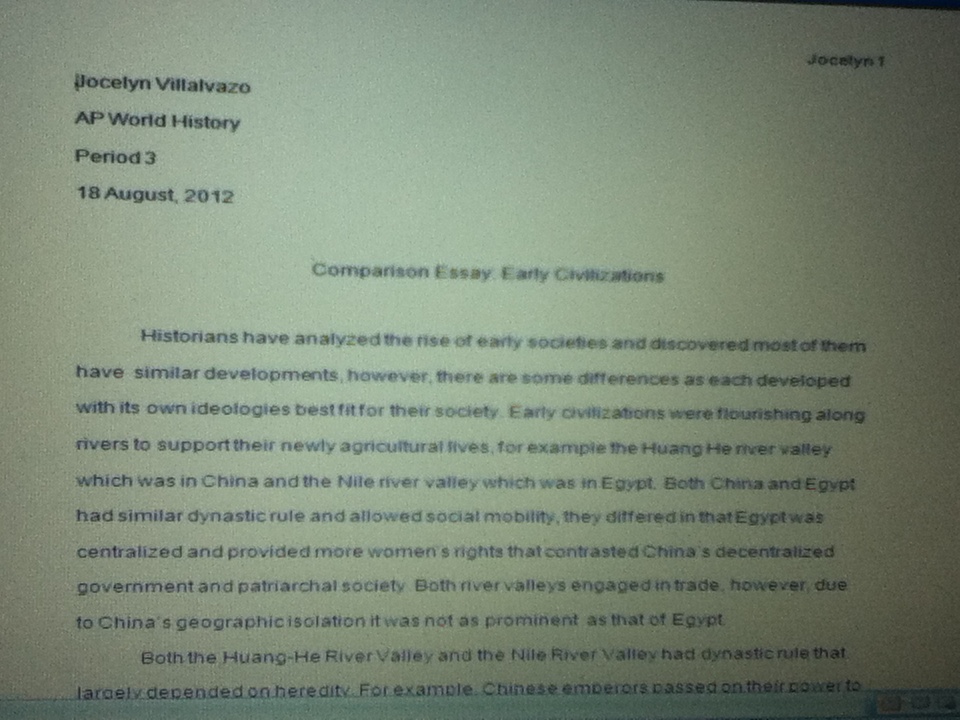 |
HTS 4: Historical Interpretation and Synthesis Reflection: Another skill we learned to master this year was the ability to interpret the past when analyzing documents, by the use of reasoning and point of view. This skill was exercised at its maximum when writing DBQ Essays and using SOAPS Tone when analyzing documents. We were encouraged to annotate the document to fill out the SOAPS Tone chart, and determine the Speaker, Occasion, Audience, Purpose, Subject and Tone. When writing point of view statements, we had to evaluate the authors opinion about the topic being discussed. On one DBQ, I remember writing a point of view statement on a document written by a women, about women working in factories and mines. The importance of this POV was that the author was an older women, which believed women should stay at home and care for the home and children, compared to younger women during that time which appreciated the opportunity to go out of their homes, and work for their own money. Another skill that I learned this year, was how to synthesize. I was able to put this skill to work when writing synthesis notes, which meant taking the most important points and condensing them to a point of understanding. Rewriting information already learned on my notes also allowed me to piece together ideas and synthesize them into one topic. Writing synthesis notes won't just help me in this particular class, but I believe it will help me in my future classes like AP English Language and other AP history courses like AP U.S. History. Evidence: The picture below is a SOAPS Tone chart I created for two distinct documents in my AP text book. In the SOAPS Tone chart, I analyzed what I believed to be the subject, occasion, purpose, and tone, for each document, I also determined the speaker and the audience of both documents. Point of view statements could be written after determining who the author was, in doing so, I would discover why who the author was, was significant. 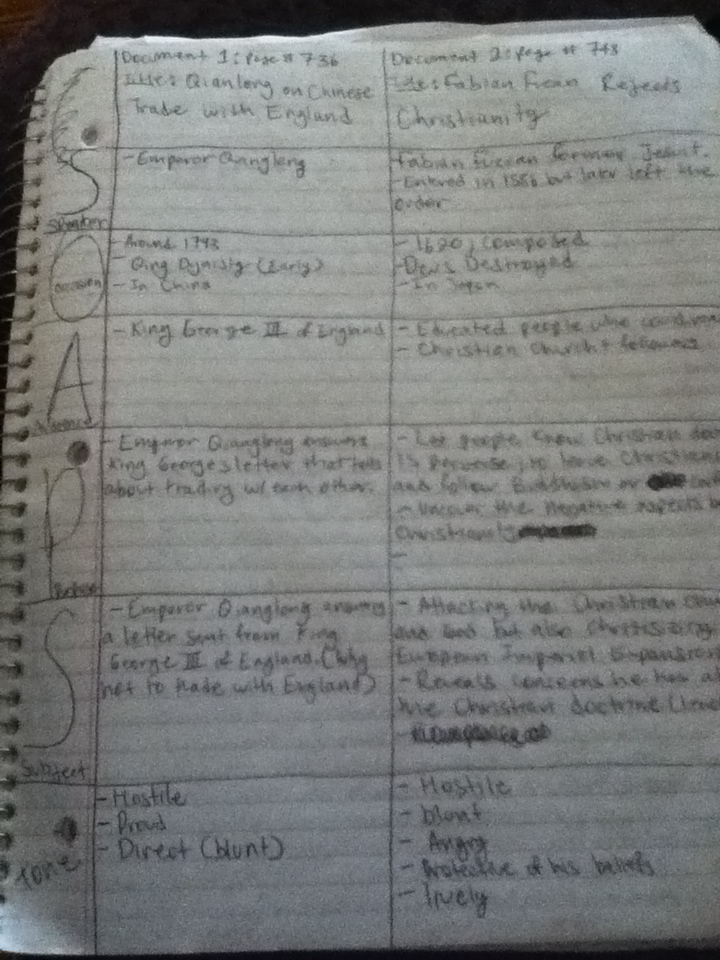 |
